
Pruning
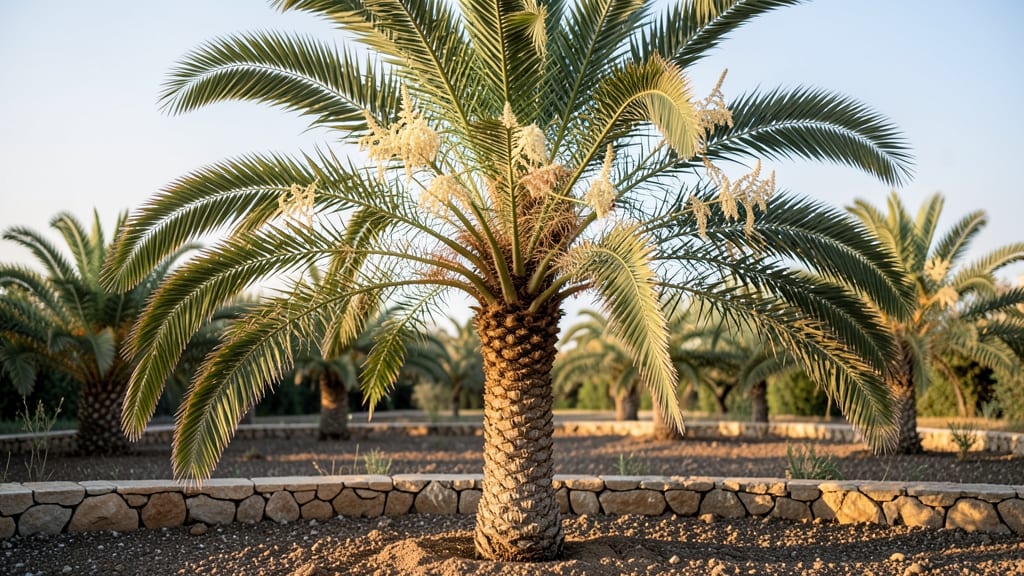
To identify male palm trees, look for no fruit production and long, slender flower clusters (spathes) emerging from the trunk or crown shaft. Their trunks grow thicker and more robust over time, as they allocate energy to growth rather than fruit development.
Male palm trees stand out because they never produce fruit, redirecting their energy into rapid vertical growth and dense foliage. 🌿 The flower clusters, or spathes, are a dead giveaway—they're long, slender, and often droop downward, unlike female flowers which develop into fruit.
I've seen this most clearly in Canary Island date palms, where males can grow 30% taller than females within a decade. For a definitive ID, check for these clusters during the spring flowering season when palms are most active.
What's interesting is that some palms, like the coconut palm, can take up to 10 years to show gender-specific traits, making early identification tricky. If you're still unsure, consider consulting a local nursery—they often track palm genetics for landscaping projects.
The key is patience and attention to detail, since juvenile palms can look identical regardless of gender.
💡 In This Article
- Key Botanical Differences Between Male and Female Palm Trees
- Practical Tips for Accurate Palm Tree Gender Identification in Landscaping
Key botanical differences between male and female palm trees
Palm trees are dioecious, meaning individual plants are either male or female—never both. This reproductive strategy is similar to holly trees or asparagus plants, where separate genders exist.
In male palms, the flower clusters (spathes) contain only pollen-producing structures called microsporangia, which lack ovules (the structures that would develop into fruit).
These spathes emerge as long, tubular inflorescences, often 3-6 feet in length, and release clouds of pollen that can travel up to 100 feet to reach female flowers.
The absence of fruit production in males is a direct result of their reproductive biology. Female palms, by contrast, develop pistillate flowers containing ovules that mature into fruit after pollination.
This energy allocation explains why male palms often grow 10-30% taller than females of the same species—studies on Phoenix dactylifera (date palms) show males can reach heights of 80+ feet while females max out around 50 feet due to the metabolic cost of fruit development.
The trunk also becomes denser in males, as they prioritize structural support for their greater height.
Under a magnifying glass, you'll notice male spathes have yellowish pollen sacs that split open to release pollen, while female spathes develop into round, fleshy fruit clusters like dates or coconuts.
In Cocos nucifera (coconut palms), male flowers produce thousands of pollen grains per spathe, creating a visible "dusting" effect when disturbed. This pollen production is so prolific that male coconut palms are often removed from orchards to prevent unwanted cross-pollination.
One fascinating exception is the palm's juvenile phase, where gender traits may not appear for 5-10 years. During this time, young palms of any gender look identical, with frond-like leaves and no visible reproductive structures.
This is why landscapers often plant multiple palms together—you might accidentally purchase a female that takes years to fruit, or a male that never produces the desired harvest. The key is to wait until the palm reaches maturity (typically 5+ years) before attempting identification.
For those curious about the science, male palms' growth advantage comes from auxin hormone dominance, which promotes vertical expansion. Females, meanwhile, redirect resources to fruit development through ethylene gas production, which triggers ripening.
This hormonal difference is why male palms often develop thicker crown shafts—a structural adaptation to support their taller stature without compromising leaf stability.
If you're working with date palms, another clue is the flowering season timing: males bloom 2-4 weeks earlier than females, as their pollen must be available before female flowers are receptive. This synchronized timing ensures successful pollination in natural settings. 🌟