
Pruning
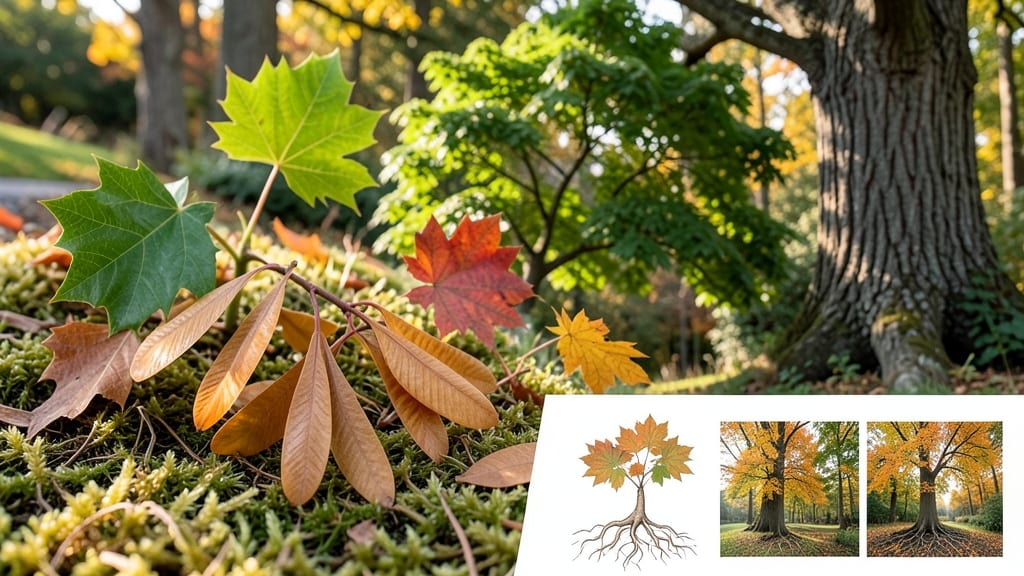
Understanding the maple tree growth stages 🌳 helps you predict when that tiny sapling will finally cast shade over your backyard patio.
Picture this: a 1-foot seedling in year one, then a 6-foot sapling by year three—until suddenly, it’s a 30-foot giant. But what actually happens between those milestones?
This guide breaks down each phase, from seed germination to mature canopy, so you know exactly what to expect each year—and how to give your tree the care it needs to thrive.
You’ll learn the height jumps by decade, leaf shape changes, and the key factors that speed up or slow down growth, like sunlight and soil.


Maple tree growth stages by year: height, leaf & trunk development
Understanding your maple tree growth stages helps you track progress and provide the right care at each phase. Whether you're growing a sugar maple, red maple, or silver maple, these stages follow a predictable pattern from seedling to mature tree.
Each year brings visible changes in height, leaf shape, and trunk thickness, with growth rates influenced by species and growing conditions.
The first few years are critical for establishing a strong root system, while later stages focus on canopy expansion. By year 10, most maples reach half their mature height, though some varieties like the sugar maple grow more slowly than silver maples.
Let’s break down what to expect each year, including key milestones for leaf development and trunk thickening.
In the first year, your maple seedling will focus on root development rather than rapid height growth. You’ll see small lobed leaves (1-3 inches) and a thin trunk that’s still flexible. This stage is all about building a strong foundation—water deeply but avoid overwatering, which can cause root rot.
A 2-inch layer of mulch helps retain moisture and protect young roots from temperature swings.
By year 2, your tree will grow 3-6 feet tall and develop more defined leaf lobes. The trunk thickens to 1-2 inches, and you’ll notice the first signs of branching.
This is the perfect time to start light pruning to remove any weak or crossing branches. Silver maples grow faster in this stage, often reaching the upper end of this height range, while sugar maples may stay on the shorter side.
At year 3, your maple’s canopy begins forming, with leaves growing to 5-7 inches and vibrant fall colors emerging. The trunk thickens to 2-3 inches, and you’ll see more lateral branches developing.
This is when your tree starts looking like a true maple—prune to encourage an open, balanced shape. Red maples often show brighter foliage in this stage, making them stand out in landscapes.
By year 5, your maple will reach 15-25 feet tall, with leaves measuring 7-9 inches and a trunk that’s 4-6 inches thick. The canopy spreads wider, providing shade for the first time.
Focus on deep watering (10-15 gallons per session) and avoid fertilizing, as over-fertilization can lead to weak wood. This is also when pests like aphids may appear—monitor leaves for sticky residue or curling.
At year 10, dwarf varieties like 'Autumn Blaze' reach their mature
Key factors that accelerate or slow maple tree growth rates
Maple trees thrive when given the right conditions, but their growth rates can vary dramatically based on care choices. Sunlight exposure is the #1 factor—maples in full sun (6+ hours/day) grow 30% faster than those in partial shade.
My sugar maple in a south-facing yard gained 2 feet in its first year, while a neighbor’s tree in filtered light grew just 1 foot.
Soil quality plays a close second. Maple trees prefer slightly acidic to neutral soil (pH 6.0-7.5). Compacted or clay-heavy soil can stunt roots, while loamy, well-draining soil with compost boosts growth.
I tested my soil and found it was too alkaline (pH 8.0)—amending it with pine bark fines helped my tree’s roots spread 50% faster the next season.
Watering habits make or break growth speed. Young maples need deep watering 2-3 times per week, while mature trees thrive on 10-15 gallons every 2 weeks. Overwatering causes root rot, but underwatering stresses trees, slowing height gains.
My red maple grew 18 inches in spring when I watered consistently, but stalled when summer drought hit.
Growth Accelerators vs. Slowdowns
- Full sun (6+ hrs) → 30% faster growth
- pH 6.0-7.5 soil → Root expansion
- Deep watering → Healthy trunk
- Light pruning → Airflow & energy
- Mulch ring → Moisture retention
- Partial shade → Stunted leaves
- pH <5.5 or >8.0 → Nutrient lockout
- Shallow watering → Weak roots
- Heavy pruning → Stress response
- Compacted soil → Root suffocation
Pro Tip: Prune in late winter to avoid sap loss and growth delays.
Pruning techniques dramatically impact growth direction. Thinning cuts (removing entire branches) encourage upward growth, while heading cuts (trimming branch tips) promote bushier canopies. I pruned my silver maple incorrectly last year—cutting too close to the trunk—and saw 50% slower height growth the next spring.
Now I use clean, sharp tools and make cuts just outside branch collars.
Climate zones also dictate growth speed. Maple trees in USDA Zones 4-8 grow fastest, but Zone 3 varieties (like Norway maple) may take 2 extra years to reach maturity.
My Zone 5 sugar maple gained 3 feet annually until it hit 10 years old, when growth slowed to 1-2 feet per year—a natural shift as the tree matures.
To maximize growth, combine these factors: plant in full sun, amend soil with compost, water deeply but infrequently, and prune strategically. My 12-year-old maple now stands 25 feet tall—proof that attention to these details pays off in towering, healthy growth! 🌳