
Pruning
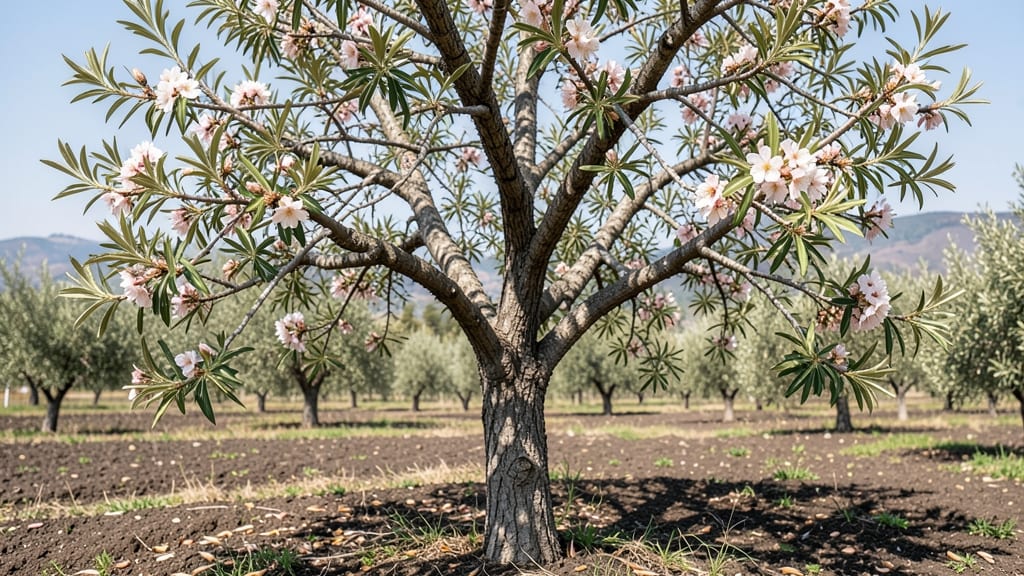
Almond trees grow best in the almond tree climate zone of USDA zones 5 through 9, where cold winters between 10°F and 20°F trigger dormancy and hot, dry summers maximize nut production. Mediterranean climates—like those in California or Spain—create ideal conditions for their growth.
The almond tree climate zone requires that cold winter chill to set flower buds, a process called dormancy. Without it, they won’t produce nuts. 🌡️ The Mediterranean climate—with its warm, dry summers and mild winters—mimics their natural habitat perfectly, reducing stress on the tree.
In regions like California’s Central Valley, these conditions create the world’s best almond-growing zones, but similar environments exist in Australia and parts of Greece.
What’s fascinating is how almond trees handle drought. Their deep roots access water from lower soil layers, making them surprisingly resilient in dry climates.
This adaptability is why they thrive in zone 9 areas like Southern California, where summers can exceed 90°F—just as long as winters stay cool enough to break dormancy.
💡 In This Article
- How Almond Trees Adapt to Mediterranean Climate Conditions
- Top Global Regions for Growing Almond Trees
How almond trees adapt to Mediterranean climate conditions
Almond trees evolved in Mediterranean climates because their biology relies on three key triggers: cold winter chill, spring warmth, and summer drought. The cold winter temperatures—typically between 10°F and 20°F—force the tree into dormancy, a survival mechanism that resets its growth cycle.
This chill period, measured in "chill hours" (temperatures between 32°F and 45°F), must accumulate for 400-800 hours annually to ensure proper flower bud formation. Without it, the tree skips flowering entirely, and no nuts develop. 🌡️
The Mediterranean climate’s hot, dry summers play a crucial role too. Almond trees are drought-tolerant thanks to their deep root systems, which can extend 10-15 feet underground to access moisture.
This adaptation allows them to thrive in regions with less than 20 inches of annual rainfall, like California’s Central Valley.
Their leaves also have a waxy coating that reduces water loss, a trait that becomes critical during the nut-filling stage, when the tree needs to conserve moisture while producing energy-rich kernels.
Sunlight is another non-negotiable factor. Almond trees require full sun exposure (6-8 hours daily) to maximize photosynthesis and energy production. In Mediterranean climates, the long, sunny days of summer provide the perfect conditions for this.
The combination of intense sunlight, warm temperatures (85°F-95°F), and low humidity creates ideal conditions for nut development. Without these elements, the tree’s energy output drops, leading to smaller or fewer nuts. 💫
Soil type also matters—almond trees prefer well-draining, slightly acidic to neutral soils (pH 6.0-7.5). Mediterranean regions often have loamy or sandy soils, which prevent waterlogging and root rot. Poor drainage can be fatal, as almond trees hate "wet feet" during dormancy.
This is why coastal areas with Mediterranean climates—like parts of Spain’s Andalusia region—are prime growing zones. The soil’s ability to drain quickly after winter rains ensures roots stay healthy, even in wetter microclimates.
What’s often overlooked is how temperature fluctuations between day and night benefit almond trees. In Mediterranean climates, days can reach 90°F+, while nights drop to 50°F-60°F. This diurnal shift helps regulate the tree’s metabolic processes, preventing stress and ensuring steady growth.
Without these natural temperature swings, trees can become vulnerable to pests or diseases. 🌅
Finally, the timing of rainfall is critical. Mediterranean climates typically receive most precipitation in winter and early spring, just as the tree begins its active growth phase.
This moisture supports early root and shoot development, while the summer drought forces the tree to focus its energy on nut maturation rather than foliage growth. This natural cycle aligns perfectly with the almond tree’s biological needs, making Mediterranean climates the gold standard for cultivation.