
Trees
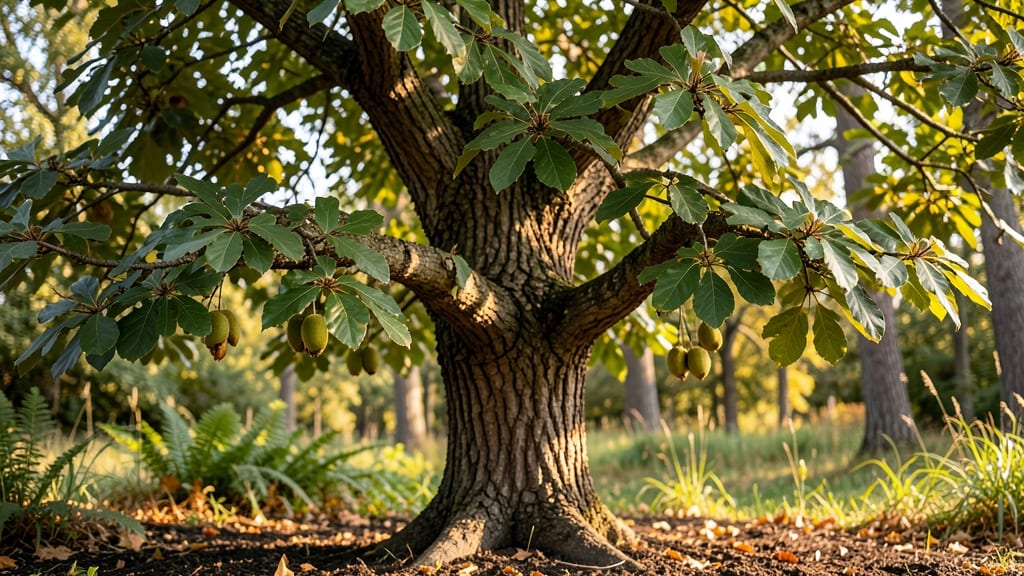
Big green tree nuts like pecans and hickory require 5 to 10 years of growth before producing usable nuts, with peak harvests typically occurring between 15 to 20 years when the tree reaches full maturity. Planting methods and care directly influence how quickly you'll see a harvest.
These towering trees demand patience because their early years focus on root and trunk development rather than nut production. 🌱 For example, a hickory tree might produce its first small crop at age 7, but those nuts won't be commercially viable until years later.
The key to faster results lies in choosing grafted trees—these mature up to 3 years sooner than seedlings because they inherit the parent tree's genetic advantages. Proper care with well-draining soil, consistent moisture, and strategic pruning can shave off another year or two from the timeline.
What's interesting is how environmental factors play into this. Trees in warmer climates with long growing seasons often reach maturity faster than those in colder regions. I've seen pecan orchards in Texas produce harvestable nuts at 8 years, while those in the Midwest might take closer to 12 years.
The right variety matters too—some cultivars like 'Desirable' pecans are bred for early bearing, potentially cutting your wait by a couple of years.
💡 In This Article
- Tree Nut Growth Stages: From Seed to Harvest
- Speeding Up Big Tree Nut Harvests: Best Practices
Tree nut growth stages: from seed to harvest
The journey from seed to harvestable nut begins with germination, where the seedling focuses entirely on establishing a robust root system and trunk.
During the first 2-3 years, you'll see minimal above-ground growth as the tree directs energy underground to anchor itself—this is why seedlings often take longer to bear fruit.
The roots can extend 3-5 feet deep by year 3, creating a stable foundation for future nut production. 🌱 In contrast, grafted trees bypass this early struggle by inheriting a mature rootstock, allowing them to allocate energy to canopy growth immediately.
Between years 4-7, the tree enters its juvenile phase, where leaf and branch development accelerate. This is when you'll notice the first small, underdeveloped nuts forming—often just a few per tree.
Pecan trees, for instance, might produce 10-20 nuts in their 5th year, but these are typically too small or bitter to eat. The key factor here is photosynthesis: trees need 6-8 hours of direct sunlight daily to build the energy required for nut development.
Shade or poor soil fertility can stall this phase by 1-2 years, while ideal conditions (like loamy, slightly acidic soil with pH 6.0-7.0) can push growth forward.
The transition to maturity occurs around 10-15 years, marked by the tree's first commercially viable crop. At this stage, the tree's height typically reaches 40-60 feet, with a canopy wide enough to support heavy nut clusters.
Hickory trees, for example, develop their signature ridged bark and begin producing 50-100 pounds of nuts annually by age 15. The science here involves hormonal shifts—once the tree's cambium layer (growth tissue) thickens enough, it triggers flowering and nut formation.
Pruning during these years is critical; removing 20-30% of competing branches redirects energy to fruit-bearing limbs.
Environmental stressors can dramatically alter this timeline. Drought conditions during critical growth years (like years 5-7) can delay maturity by 3-5 years as the tree prioritizes survival over reproduction. Conversely, consistent irrigation and mulching with organic matter (like wood chips) can improve soil moisture retention by 30-40%, accelerating growth.
Temperature also plays a role—trees in USDA zones 7-9 (like Georgia or Texas) mature faster than those in cooler zones (like zone 5) due to longer growing seasons.
For instance, a pecan tree in Louisiana might bear harvestable nuts at 8 years, while one in Minnesota could take 12-14 years.
What most growers overlook is the role of mycorrhizal fungi in the soil. These beneficial microbes form symbiotic relationships with tree roots, increasing nutrient absorption by up to 80% during the juvenile phase.
Adding compost or fungal inoculants at planting can shave 1-2 years off the timeline by boosting early growth. The difference between a seedling and grafted tree becomes stark here: grafted trees often produce their first marketable crop 3 years earlier because they inherit the parent tree's established root-fungus network.
By year 15-20, the tree reaches its prime, producing 200-500 pounds of nuts annually under optimal conditions. The nuts themselves develop through a 60-90 day growth cycle, starting as tiny flowers in spring and maturing in fall.
This is when proper thinning becomes essential—removing 50% of excess nuts ensures the remaining ones develop fully, rather than staying small and stunted. 🌟 The result is a tree that not only survives but thrives, turning sunlight and soil into a bountiful harvest.