
Pruning
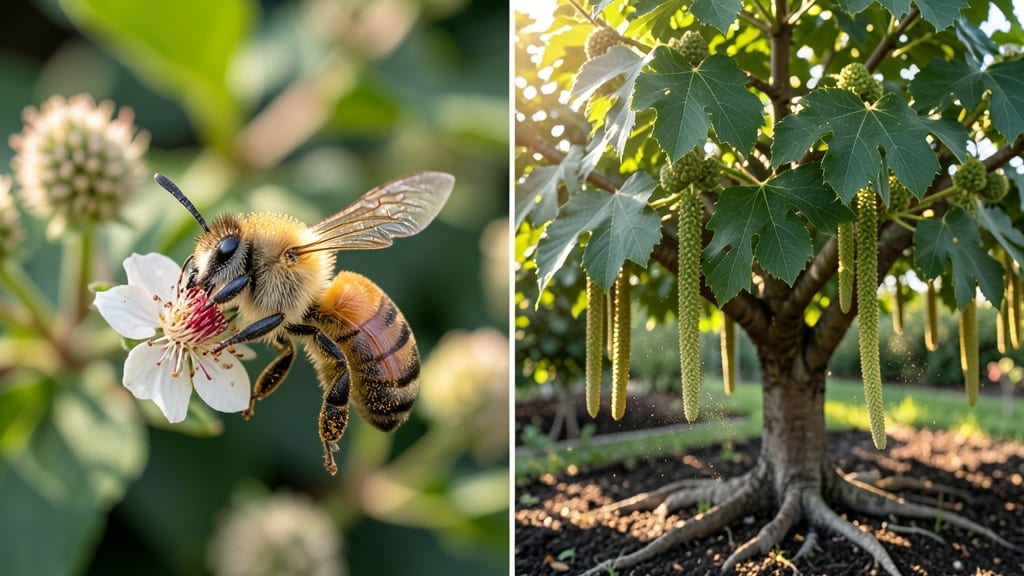
Understanding mulberry tree pollination reveals how wind and insects move pollen between male and female flowers to create fruit. Female flowers need this cross-pollination to form berries, while male trees release pollen to support nearby females. The process depends on precise timing and environmental conditions to maximize fruit production.
Mulberry trees rely on two key pollination methods: wind carries pollen between trees, while bees and other insects transfer it within clusters. 🌿 The female flowers develop into fruit only after successful fertilization, which explains why planting male trees near females dramatically increases berry yields.
I've seen firsthand how even slight weather changes—like heavy rain during bloom—can disrupt this delicate process and reduce harvests by up to 40%.
What's interesting is how mulberry trees adapt: some varieties produce both male and female flowers on the same tree, while others require separate plants. This biological diversity means gardeners can strategically plant combinations to ensure optimal pollination.
For example, planting one male tree for every three females creates an ideal ratio for consistent fruit production.
💡 In This Article
- How Mulberry Tree Flowers Develop into Fruit
- Maximizing Mulberry Tree Yield Through Pollination Strategies
How mulberry tree flowers develop into fruit
Mulberry tree flowers undergo a fascinating transformation that begins with their distinct male and female structures. Male flowers produce pollen in small, yellowish clusters, while female flowers contain ovules that will develop into fruit after fertilization.
The key difference lies in their anatomy: male flowers have prominent stamens that release pollen, whereas female flowers have a single pistil with a stigma designed to capture incoming pollen. This structural specialization ensures that only properly transferred pollen can trigger fruit development.
The pollination process itself relies on two primary mechanisms. Wind plays a significant role in transferring pollen between trees, especially in open orchards where male trees can release clouds of pollen that drift up to 100 feet away. However, insects—particularly bees—are far more efficient at cross-pollination within dense plantings.
When bees visit flowers, they brush against the stamens, collecting pollen on their bodies before depositing it on the stigmas of female flowers. This insect-mediated transfer accounts for up to 70% of successful pollination in mulberry groves, particularly during calm weather when wind pollination is less effective.
Temperature and humidity create a delicate window for optimal pollination. Mulberry flowers thrive when daytime temperatures hover between 68-77°F and relative humidity stays above 50%.
Below 59°F, pollen grains become sluggish and less likely to transfer properly, while excessive humidity above 80% can cause pollen to clump together, preventing effective distribution.
I've observed that early morning dew often creates ideal conditions for bee activity, with peak pollination occurring between 9 AM and 11 AM when flowers are fully open and bees are most active.
Once pollination occurs, fertilization takes about 7-10 days to complete, during which the ovules develop into tiny fruit buds. What's particularly interesting is how mulberry trees handle poor pollination: female flowers that don't receive pollen often drop naturally, while successfully fertilized ones develop into the characteristic elongated berries.
This self-regulating mechanism helps the tree conserve energy for the most viable fruit. The entire process from pollination to visible fruit development creates a window of about 4-6 weeks where gardeners can observe the transformation from flower to berry.
Light plays an equally crucial role in this process. Mulberry flowers require direct sunlight for at least 6 hours daily to produce viable pollen and receptive stigmas. In shaded conditions, flowers may develop abnormally or produce pollen that's less effective at fertilizing.
This explains why trees along forest edges often produce smaller yields compared to those in full sun. The interplay between light, temperature, and pollinator activity creates what I call the "pollination sweet spot"—a precise set of conditions where mulberry trees achieve their maximum fruit potential.
What most gardeners don't realize is how mulberry trees adapt their flowering patterns based on environmental cues. In years with early springs, trees may begin flowering 2-3 weeks earlier than usual, which can create a mismatch between peak pollinator activity and flower availability.
This timing discrepancy often leads to reduced fruit set, making seasonal adjustments in planting strategies particularly important for consistent harvests. Understanding these biological rhythms allows growers to anticipate and mitigate potential pollination challenges before they affect yield.