
Plants
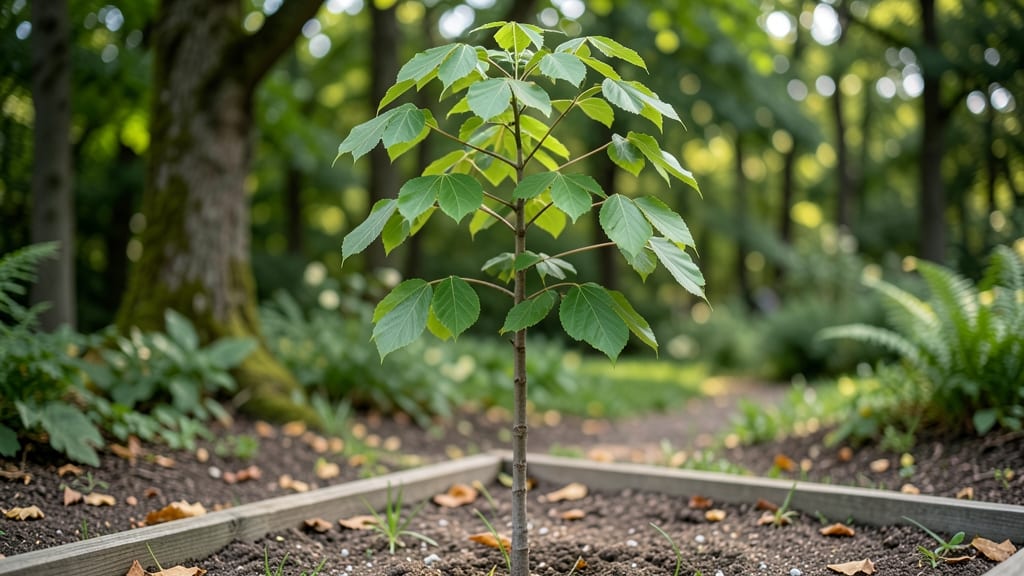
A young walnut tree looks like a slender, upright plant with smooth grayish bark marked by tiny vertical lenticels, compound leaves featuring 5-9 serrated leaflets, and a delicate structure that sets it apart from mature trees.
A young walnut tree's most striking feature is its delicate foliage, which unfurls in early spring with bright green, finely serrated leaflets that create a lacy appearance. 🌿 Unlike mature trees with thick, deeply grooved bark, young specimens maintain a sleek, almost silvery-gray surface that reflects sunlight.
The leaves' resemblance to hickory trees can be confusing, but walnut leaves are noticeably more refined, with a softer texture that feels almost velvety to the touch. This early growth stage lasts 5-10 years before the tree develops its signature rugged, furrowed bark and broader canopy.
What makes identification easier is observing the leaf arrangement—walnut leaves grow in alternating patterns along the stem, while the individual leaflets typically number between 7-9 (though sometimes 5-11).
The bark's lenticels, those tiny vertical slits, become more pronounced as the tree ages, but in saplings they're subtle enough to require close inspection.
I've found that young walnut trees in full sun develop slightly darker green leaves compared to those in partial shade, where the foliage takes on a more muted, bluish-green hue.
💡 In This Article
- Distinguishing Young Walnut Tree Leaves from Other Nut Trees
- Bark and Growth Pattern Evolution in Early Walnut Tree Development
Distinguishing young walnut tree leaves from other nut trees
The compound leaves of a young walnut tree are its most distinctive feature, with 7-9 serrated leaflets (though sometimes 5-11) that create a fine, feather-like appearance.
Each leaflet typically measures 2-6 inches long and 1-2 inches wide, with edges that have 15-25 sharp serrations per inch—more refined than hickory leaves, which have broader, more rounded teeth.
The terminal leaflet is noticeably larger than the others, a key difference from pecan trees where leaflets are more uniformly sized.
Sunlight dramatically alters leaf appearance: in full sun, young walnut leaves develop a vibrant green color with a slightly waxy sheen, while shaded specimens take on a bluish-green hue and appear thinner. 🌞 The leaf arrangement is another clue—walnut leaves alternate along the stem in a spiral pattern, unlike butternut trees which often have opposite leaf arrangements.
When crushed, walnut leaves release a faint, sweet, almost almond-like aroma due to juglone compounds, a chemical marker absent in other nut trees.
Seasonal changes reveal additional differences: in spring, new walnut leaves emerge bright red or bronze before turning green, while hickory leaves unfurl yellow-green first. By autumn, walnut leaves develop golden-yellow or brownish hues before dropping, whereas pecan leaves often retain green longer.
The leaf stems (petioles) on walnut trees are stout and hairless, another distinguishing factor from fuzzy-stemmed butternut leaves.
Here's how to compare key leaf features at a glance:
- Walnut: 7-9 fine serrated leaflets, alternate arrangement, bright spring color, hairless stems
- Hickory: 5-7 broader leaflets, opposite arrangement, yellow-green spring, coarser texture
- Pecan: 11-17 leaflets, uniform size, green spring, longer petioles
- Butternut: 9-17 leaflets, fuzzy stems, yellow fall color, opposite arrangement
The most reliable identification method is examining the leaflet serration pattern: walnut leaflets have fine, sharp teeth (like a saw blade), while hickory leaflets have rounded lobes. This difference becomes more pronounced as the tree matures, but is visible even in saplings. 🔍